Wednesday, 1 January 2020

Steel production was key to great power status


In recent history steel was the most important thing for winning wars. Notice how the top four producers of steel from 200 years ago are permanent members of the UN security council?


The missing permanent member is China, which now produces quite alot:
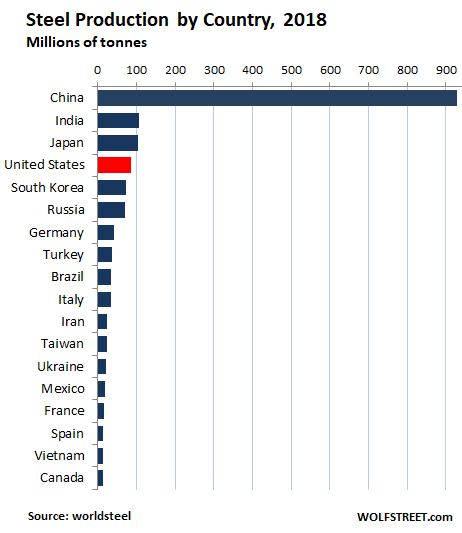
Image result for country comparison steel production

However these days steel isn't the most important thing for winning wars. Information technology for intelligence gathering, disimformation, smart weapons command and control and many other things is critical. This is why a lot of the China - US trade war revolves around the US trying to prevent too much information technology transfers (as well as protecting strategic US steel & alumunium industries from Chinese undercutting). More to follow.

Wednesday, 7 November 2018

The problem of consciousness and the singularity

I've put a talk together on consciousness & individuality : what these concepts are and how technology will impact them
Youtube video of talk here 

Tuesday, 31 July 2018

Boston bombers radicalisation memetic cookbook

I've been following the Boston bombers with great interest.

Stratfor is of the opinion that Inspire magazine helped radicalise Tamerlan as well as give him the knowledge for creating rudimentary explosive devices.


First off, what do I mean by radicalisation in the context of terrorism? Well fundamentally it's about using a person to carry out terror by indoctrinating them into believing it is a righteous cause worth dying for. They are a pawn, or to use Dan Dennett's excellent example, an ant:


Is there anything that can be done about Internet-enabled radicalization?
Authorities assessing the motivations of the bombing suspects appear convinced that Tamerlan and his younger brother, Dzhokhar Tsarnaev, were self-radicalized, “lone wolf” terrorists. Just as they may have gotten their recipe for pressure-cooker bombs from the Internet, so, too, it looks as if they entered cyberspace to indoctrinate themselves with ideas that justified blowing up innocent people.


The obscure Russian jihadist whom Tamerlan Tsarnaev followed online
To summarise, he was a nobody terrorist fighting for Dagestani independence from Russia who put out a few YouTube videos

The Boston bombings give an interesting insight into Islamic radicalisation without any exposure to external networks

Tamerlan, the older brother, had been watching radical preachers who were talking about the need for non-Arabs to be warriors for Allah.

He is named after a non-Arab warrior who ruled a great Muslim empire which included Chechnya

http://en.wikipedia.org/wiki/Timur

http://en.wikipedia.org/wiki/File:Timurid_Dynasty_821_-_873_(AH).png


http://blackflags1.blogspot.com.au/

kyrgyzstan


YouTube account that appears to have been run by Tsarnaev includes a playlist devoted to "terrorism", including one video in English titled The Emergence of Prophecy: The Black Flags from Khorasan. He also maintained a playlist devoted to Islam and one devoted to Timur Mutsuraev, a Chechen singer who sang of the republic's battle for freedom from Russia.


http://www.bostonglobe.com/metro/2013/04/19/relatives-marathon-bombing-suspects-worried-that-older-brother-was-corrupting-sweet-younger-sibling/UCYHkiP9nfsjAtMjJPWJJL/story.html

timerlan

radicalisation

terror


Allah's Mountains: The Battle for ChechnyaThe I.D. Forger: Homemade Birth Certificates & ​Other Documents Explained, and How to Win Friends & Influ​ence People, among other works:


Latest Stratfor: CIA-funded radicalisation of Tamerlan?
http://www.stratfor.com/geopolitical-diary/izvestias-report-and-boston-bombing

http://www.infowars.com/tamerlan-tsarnaev-attended-cia-sponsored-workshop/?utm_source=twitterfeed&utm_medium=twitter

http://www.washingtonpost.com/blogs/worldviews/wp/2013/04/24/the-obscure-russian-jihadist-whom-tamerlan-tsarnaev-followed-online/


stratfor on bombing and inspire magazine


inspire magazine


memetics

Dennett on dangerous ideas


kids = ant all terrain vehicle


Sunday, 22 April 2018

Letting future self have more say on decisions

After having two nights out drinking last week I have question: How do I let future me have more input into decisions present me makes? Apps, behaviour modification, etc. Our brains have evolutionary survival feedback mechanisms which are obsolete and somehow need to be overcome / hijacked.
Brainstorming I can think plan and review calendar for work but coming up short on finances and health. Finances you have "you have spent X" notifications, health you can have a "go for a run" notifications which are pretty primitive.
What I'm kind of thinking you need is a C3PO whispering in your ear a predictive behaviour outcome feedback... e.g. your google maps location shows an 80% probability that you are walking to a bar. Given it's a Tuesday you are likely to consume >5 drinks which will likely mean you will carbload and skip exercise for 4 days. This means in 1 week you will be X kg heavier and your like expectancy will have decreased by X days. A more medium long term feedback would be: given you are entering a bar towards the end of a 16 day period not going to a bar, you are at risk of not completing a 21 day behaviour modification of reducing bar attendance which will lead to a projected uplift of bar attendance events of X per year, leading to a projected.... you get the point.

Monday, 11 January 2016

Chomsky, Sanders, SOPA, TPP and the migration of popular movements online

Bernie Sander's campaign is going very well, rising in the polls massive online presence, he may not be winning in the main stream press but his online presence towers over Hillary's. Need to flesh this out a bit, facts & figures on social media engagement, Hillary trust issues etc.


Noam Chomsky has a more pessimistic outlook on Bernie's campaign. For a start e doesn't believe Sanders will get nominated, and even if we were nominated he doesn't believe he would be able to implement the policy change that appeals to his base due to a lack of clout within the American political & financial establishment.  

Instead Chomsky would prefer it if Bernie prepared his support base for a long term populist uprising, independent of election cycles. This is taken from an interview with the Institute for Public Accuracy titled: Noam Chomsky: Electing the President of An Empire


Noam Chomsky:Take, say, the Bernie Sanders campaign, which I think is important, impressive. He’s doing good and courageous things. He’s organizing a lot of people. That campaign ought to be directed to sustaining a popular movement that will use the election as a kind of an incentive and then go on, and unfortunately it’s not. When the election's over, the movement is going to die. And that’s a serious error.
The only thing that’s going to ever bring about any meaningful change is ongoing, dedicated, popular movements that don’t pay attention to the election cycle. It’s an extravaganza every four years. You have to be involved in it, so fine. We’ll be involved in it, but then we go on. If that were done, you could get major changes.

Noam believes that using the parliamentary system to make popular policy change is impossible in the United States, rather the political establishment now serves the interested of the Plutocracy exclusively:
There’s very good polling evidence on what people think about things. So for example for about 40 years, a considerable majority of the public has thought that taxes should go up on the rich. Taxes go down on the rich. A substantial part of the public, often a big majority, thinks that we ought to have a national healthcare program. Nothing. Impossible. In fact when the press discusses this they call it “politically impossible.” Meaning the pharmaceutical companies won’t accept it, the insurance companies won’t accept it, and so on. So it basically doesn’t matter what the public thinks.
About 70% of the public, the lowest 70% on the income scale, are pretty much disenfranchised. Their attitudes have no detectable influence on the policies of their own representatives. As you move up the scale you get a bit more influence. When you get to the top, policy is made. 
Now the top can mean a fraction of 1%, so it’s kind of a plutocracy with democratic forms. And the elections, I mean by now it’s almost become a joke but it’s always been true that campaign financing plays a very substantial role in not only who’s elected but what the policies are. That goes back 100 years. Mark Hanna, the great campaign manager 100 years ago, was asked once, “What are the important things that you have to have to run a campaign?" He said: “There are three things. First one’s money. The second one is money. And I forget what the third one is.”
I'm necessarily not sold on this argument. There is ample evidence that popular movements can influence policy, provided the public have a powerful advocate. In more recent times these powerful advocates seem to be concentrated in high tech companies which rely on online social networks such as Wikipedia, Google and Facebook.


Case in point - The "Internet blackout" to stop SOPA legislation


For instance, when media companies tried to push through SOPA (Stop Online Piracy Act) which was arguably detrimental to the common man, it was met with a very effective campaign by Wikipedia, Google, Facebook and others which managed to derail the bill by crowd sourcing an online petition and email campaign to elected representatives:


The campaign led to one million emails being sent to elected representatives protesting the bill along with a petition containing the names of 10 million voters. This lead to the scrapping of the bill.

Now arguably this could just be large technology platform content providers protecting their own interests as opposed to a true grassroots movement. In my opinion, the true nature of this phenomena will become apparent when TPP legislation is attempted to be enforced.


The next test will be the TPP

In order to validate whether this approach will continue to be successful will in my opinion come if the implementation of elements of the transpacific partnership (TPP) which are deemed to be detrimental to society at large is met with similar online protests orchestrated by the big tech and social media players. I can see protest arising regarding intellectual property law, as well as new pharmaceutical regulation.

Sunday, 27 September 2015

Journalists I read

This is my regular reading list: I'll add more detail on why I like these guys when I get round to it, but take it from me, if you want to know how the world really works, read these guys.


Taki Theodoracopulos


His spectator column the high life is probably the best column you can read on a week by week basis. The man exudes crass intellectualism and refined vulgarity. He can also write.  He also runs The American Conservative, which has a rather reasonable take on what America's role should be on the world stage.


Gary Brecher: The War Nerd


Best geopolitical analysis on the Internet, and like Taki, he can write! He now has a patron podcast, radio war nerd


George Friedman


Second best geopolitical analysis on the net


Sunday, 23 August 2015

Bernie Sanders - No Empire at the expense of the people

I can see strong parallels between the American and Roman elites who benefit from an international system which favours their military and economic hegemony at the expense of the middle classes which got them their initial military victories.  

In the case of Rome, Empire lead to the decline of the economic livelihood of small tenant farmers of the Italian peninsular as the Roman republic transformed into the slave based economy of the Roman empire, following victories against the Carthaginians, Gauls and Greeks. In the case of the United States, military victories against the Germans, Japanese and Russians have lead to a financial system dominated by the U.S. dollar where neoliberal economic policies favour free trade, deregulation and labour outsourcing to the detriment of the American working and middle classes.

As both Bernie and Trump are pointing out, the outsourcing of manufacturing and services jobs to low cost countries like China and India provides a short term economic gain for fortune 500s but creates a long term structural weakness in the American domestic economy. This the the true price of military victory: the hollowing out of the victor nations middle and working classes, which lead to the eventual decline of both the Roman empire.

I haven't done a great deal of "stitching" on this one, but I want you to look at some excerpts around current US economic policy and compare it to the economic policy of the Roman empire, once it moved from a free hold peasant farmer based economy to a slave based economy.


Bernie Sanders on the Late show with Stephen Colbert
Sanders and his host had a lengthy discussion on problems facing the U.S., calling it a "moral outrage that the top one-tenth of 1% today owns almost as much wealth as the bottom 90%, and that 58% of all new income is going to the top 1%." He explained that, while he wanted an entrepreneurial society, Sanders didn't believe there could be one while so much economic power was in the hands of the ultra-wealthy.

Bernie Sanders is presenting himself as the champion of the middle class who is not in the pocket of the wall street financial elite, like "establishment" candidates, America's Neo-aristocracy: Hillary Clinton and Jeb Bush


To what extent were economic factors to blame for the deterioration of the Roman Empire in the Third Century A.D?


After the second Punic war many new economic transformations began. During this time, many of the best agricultural lands in Italy were devastated. Many wealthy opportunists had profited during the war and were no longer inclined to finance small farmers. There were new possibilities for business of a less insecure and therefore more tempting nature. Contact with Carthage had opened the eyes of many greedy Romans to the profitability of scientifically managed large-scale agriculture. This combined with a new abundance of cheap land and slaves initiated two new economic developments. Men with money started to buy these huge areas of land, formed large estates, and set about working them for profit with the new cheap and plentiful supply of slave labour. Connected to this was the increasing tendency of small cultivating owners to choose not to resume their interrupted occupation or to even be driven to abandon their holdings. The only hope of halting this economic development lay in the political sphere but power was steadily passing into the hands of the very men who profited from this new system.
The growing number of provincial taxes brought into being a large class of investors whose speculations tended to generate substantial returns. This ever-expanding and highly important class known as the Knights (equites) had little care for the rapidly disappearing peasantry. Initially their main activity was to squeeze concessions from the Senate thereby meaning that for a time popular leaders were able to engage their support against the ruling nobility. However, selfish interests gradually became the guiding force and they joined with the senatorial nobles to form a party of property. In light of this it is hardly surprising that efforts to restore free peasants to Italian land were a failure. The main area of commerce in the latter days of the Republic was the slave trade and therefore Roman financiers were deeply interested in this. Any attempts to reform the system were normally met with hostility. 
Empire and budget deficits go hand in hand

The system fell into such disarray that that by 284 A.D, the condition of the small tenant farmer had generally become one of semi-servile dependence. His legal freedom became very limited and his economic position increasingly depended on the preservation of a holding often blighted by encroachments. If he left his land he would probably starve but if he stayed then he effectively be a serf. Legal changes later on made it the case that to be a colonus was to be attached to a specific plot of ground with which he himself was transferable. This change, however rational it may have been under the circumstances really only confirmed what a mess Rome had made of its economy and all this did was to effectively consummate agricultural stagnation by law.

This very same economic conundrum is affecting the United States: there is the same misalignment between the interests of the financial-military industrial complex and the middle class that there was in the Roman Empire.

Here is an excerpt from a ZeroHedge article on the economic policy decisions the United States has made over the last half century:


The Unlikely Rise Of Donald Trump And Bernie Sanders


Although the economy successfully created a broad path to the middle class, it was inefficient. Persistent inflation became a serious issue. To address inflation, President Carter implemented a series of supply side measures designed to improve the efficiency of the economy. These included the deregulation of financial services and transportation. He also appointed Paul Volcker as Federal Reserve Chairman; he implemented a “hard money” monetary policy. President Reagan took Carter’s reforms and expanded them further, leading to additional deregulation and globalization.
The good news was that the policies brought inflation under control. The problem was the broad path to the middle class in the developed world was dramatically narrowed. To now survive in the labor force, workers needed to rapidly adapt to new technologies and methods and compete on a global scale. Those who could were greatly rewarded; those who could not were left behind.


This chart shows the share of total income captured by the top 10% of income earners and inflation as measured by CPI. As the data shows, when this share is above 42%, inflation tends to be non-existent. When the top 10% share is below 42%, the CPI average is 5.3%. Inequality isn’t necessarily the cause of low inflation, but deregulation and globalization, which are effective against inflation, tend to cause increasing income inequality.
This led to a conflict between domestic and foreign policy. Containing inflation was a key domestic goal, but widening income differentials weakened the average household’s ability to consume, which undermined the reserve currency role of the superpower. The way the U.S. resolved this conundrum was through debt.
Using debt to address the requirements of providing the reserve currency was never going to be a permanent solution to the problem of running a domestic economy and meeting the requirements of global hegemony. However, as long as credit was widely available, the political situation was manageable. The financial crisis of 2008 has made it clear that the debt option is no longer viable. And, to a great extent, the election of 2016 should be about answering these two questions:
  1. Should the U.S. continue to act as global hegemon, which includes providing the reserve currency?
  2. If the answer to 1. is yes, then how should the economy be restructured in order to fulfill the hegemon role in a sustainable fashion?