Saturday, 14 March 2026

The Human-Scale State

Every civilisation that has ever existed has faced the same problem: how do the many govern themselves without the few capturing the machinery of governance?

Every answer, philosopher kings, theocratic guardians, vanguard parties, representative democracy, has followed the same arc. A system is designed to serve the people. A class emerges to operate it. That class begins to serve itself. The system decays. The people suffer. Eventually the system collapses or is overthrown, and a new one is built on the rubble. The cycle restarts.

This is not a failure of particular leaders or particular ideologies. It is a structural problem. Governance at scale requires institutions, and institutions can be captured. Every abstraction between the governed and the governors, every law, every committee, every electoral mechanism, is a surface for corruption. The cycle persists because every previous system has relied on the same flawed assumption: that the right people, the right institutions, or the right ideology can be trusted to govern at scale. They cannot. Not because people are uniquely evil, but because the incentive structures of centralised power eventually corrupt whoever holds it.

Human-Scale Governance is a system where every citizen can vote directly on any policy, or delegate their vote to someone they trust in a specific domain, and revoke that delegation at any time. All of this is transparently managed through a decentralised on-chain system. Delegations are transitive (your delegate can further delegate), fully transparent, and capped at a maximum, for example 150 people per delegate per policy area. The point is not that 150 is a sacred number. The point is that delegation must remain human-scale: small enough to prevent celebrity aggregation, large enough to permit real networks of trust, and limited enough that accountability runs both ways. It is not only about you knowing your delegate. It is about your delegate still being close enough to know the people whose trust they hold. This prevents the core pathology of representative democracy, where your representative has never met you and never will, along with party capture, careerism, opaque lobbying, and durable concentrations of unearned influence. It will not prevent all gaming, but it constrains failure to the scale where people still know each other’s names.

Participation is funded. Athens paid citizens to attend the assembly for a reason: governance takes time, and time has a cost. In this system, civic participation is compensated. You get paid to govern. Not to vote on everything, but to participate meaningfully: reviewing proposals, deliberating with your delegates, casting informed votes, and monitoring how your delegated trust is used. This is not a handout. It is compensation for civic labour. As automation displaces traditional labour, governance becomes one of the few forms of socially necessary work that cannot simply be handed to an algorithm without recreating the very problem this system exists to solve.


Part I: The Problem

1. Plato's Philosopher Kings

Twenty-four centuries ago, Plato diagnosed democracy as a degenerative condition. In the Republic, he ranked it second from the bottom of all governance forms, above only tyranny, and barely. Democracy, he argued, drowns in its own freedom. Too many voices, too many appetites, no coherent direction. The people, overwhelmed, eventually hand power to a strongman who promises order. Democracy produces the tyrant it was supposed to prevent.

Plato's solution was a guardian class. Rulers selected for wisdom, trained from birth in philosophy, stripped of property and family so they would have no personal interests to corrupt their judgement. They would govern not because they won a popularity contest, but because they understood the Good.

It is the most elegant argument for enlightened rule ever written. It is also fatally flawed.

The flaw is not in the logic but in the implementation. Who selects the guardians? The guardians. Who assesses wisdom? The wise. The moment a ruling class is empowered to define its own membership criteria, it selects for loyalty, not competence. For self-preservation, not service. Wisdom becomes whatever the ruling class says it is.

Plato never solved this. No one has.

2. The Catholic Church: Plato at Continental Scale

The medieval Catholic Church was the closest thing Europe ever produced to Plato's Republic in practice. A transnational ruling class selected by education rather than birth. Bound by vows of celibacy and poverty, theoretically stripped of family and property, just as Plato prescribed. Governing through moral and intellectual authority rather than military force. Trained in philosophy, theology, and law. Answerable to a hierarchy that culminated in a single guardian: the Pope.

For centuries, it worked. The Church provided Europe with a shared institutional framework, a common language of governance, a mechanism for resolving disputes between kingdoms. It was the operating system of Western civilisation.

Then the guardian class enriched itself. The Borgias turned the papacy into a family enterprise. Indulgences turned salvation into a revenue stream. Monasteries became landlords. Bishops became princes. The institution that was supposed to transcend material interest became the most materially corrupt institution on the continent.

The philosopher king became the philosopher landlord. The guardian class became the aristocracy it was designed to replace. Luther's Reformation was the inevitable correction, the governed rejecting the governors. What followed was a century of religious wars and the rise of the nation-state.

The structural lesson is clear: any class that governs because it claims superior wisdom will eventually use that claim to justify its own enrichment. The claim of wisdom is the instrument of capture.

3. The Soviet Politburo

Marxism-Leninism was another attempt at the guardian class. The Communist Party as a vanguard, the most politically conscious segment of the proletariat, governing on behalf of the whole. Selected by ideological commitment, trained in dialectical materialism, organised through democratic centralism.

The theory was Platonic at its core: a ruling class that understands the laws of history, governing for those who do not yet understand.

The decay followed the same pattern, only faster. Within a generation, the vanguard party became the nomenklatura, a hereditary elite with access to special shops, dachas, hospitals, and schools denied to ordinary citizens. Information stopped flowing upward because subordinates learned that bearing bad news was career-ending or fatal. Central planning failed not because planning is impossible in principle, but because the planners were insulated from reality by their own power.

Competence was replaced by loyalty. Succession became crisis. Stalin's death produced a power struggle. Brezhnev's era produced stagnation. Gorbachev's reforms produced collapse. The system that claimed to govern for the workers governed for the apparatus.

The nomenklatura served the nomenklatura. The vanguard became the thing it was supposed to destroy.

4. The Chinese Communist Party: The Clock Is Running

Deng Xiaoping understood the Soviet failure better than anyone. After Mao's catastrophic one-man rule, the Great Leap Forward, the Cultural Revolution, tens of millions dead, Deng designed the most sophisticated set of structural constraints on the philosopher king problem in modern authoritarian history.

Term limits. Collective leadership. Mandatory retirement ages. Factional balance within the Standing Committee. No single leader could dominate. Power rotated. The guardians policed each other. It was not democracy, but it was a system that at least acknowledged the core problem: unchecked rulers decay. The mechanism was not elections but institutionalised turnover.

For thirty years, it produced competent governance at extraordinary scale. China's rise from poverty to the world's second-largest economy is substantially a product of Deng's institutional design.

Xi Jinping abolished those constraints in 2018. He removed term limits, purged rival factions under the banner of anti-corruption, stacked the Standing Committee with personal loyalists, and eliminated collective leadership. China has reverted to the one-man model.

The symptoms are already visible. Information decay: Xi's COVID lockdowns continued long past the point of rationality because no one in the system could tell him they were not working. Competence erosion: the new Standing Committee is composed of Xi's men, not necessarily the most capable administrators. Succession void: there is no heir apparent, no orderly transfer mechanism. When Xi goes, whether through death, illness, or crisis, there is no plan.

History suggests the interval between the breakdown of succession mechanisms and structural crisis is usually measured in decades, not centuries. Deng's system was the best answer anyone has produced to the guardian class problem within an authoritarian framework. Xi is unlearning those lessons in real time.

5. Western Democracy: Ritual Without Faith

Democracy was supposed to be different. Not rule by the wise, but rule by the people. The governed choose the governors. If the governors fail, the governed replace them. Accountability through elections. Legitimacy through participation.

It has become a ritual. The forms persist, elections are held, votes are counted, winners are sworn in, but the substance has drained away.

In 2019, Ukrainians elected Volodymyr Zelensky in a landslide on a platform of peace with Russia. He could not deliver it. Structural forces were stronger than the democratic mandate. In 2016, Americans elected Donald Trump in part on a promise of no more forever wars. The wars continued. The permanent state, the intelligence agencies, defence contractors, the foreign policy establishment, all operate on a timeline longer than any election cycle. Presidents come and go. The contracts continue.

Both electorates said some version of the same thing: stop the wars, fix what is broken at home. Both got the opposite of what they voted for.

This is not a failure of two leaders. It is a structural revelation. On the questions that matter most, war and peace, the distribution of wealth, the relationship between citizen and state, the democratic mandate does not reliably control policy. A professional class of administrators, lobbyists, intelligence operatives, donor-funded think tanks, and permanent officials makes the actual decisions. Elections determine which face reads the teleprompter.

Robert Michels identified this a century ago as the Iron Law of Oligarchy: every organisation, no matter how democratic its founding intentions, eventually develops a ruling minority that serves its own interests. The party apparatus, the committee system, the donor class, the media gatekeepers. These are the actual governing structures. The ballot box is the legitimation ceremony.

Democracy has become what Jesus condemned in Matthew 6:5, the hypocrites who pray standing on street corners to be seen by others. Performative piety. The form without the faith. Citizens participate in the ritual not because they believe it changes anything, but because the alternative, admitting the system is captured, is too destabilising to face.

The disillusionment is accelerating. Brexit. Trump. Meloni. Milei. These are not merely ideological movements. They are protest votes from populations who have correctly observed that the policy output often does not change much regardless of which party holds office. Voter turnout across parts of the West is softening. Trust in institutions is at historic lows. The people are not apathetic. They are accurate.

6. The Root Cause: Human Limits

Every system described above fails for the same reason. Not because the wrong people were in charge, but because governance at civilisational scale is a problem humans are not cognitively equipped to solve through direct social trust alone.

Humans can maintain only a limited number of stable, meaningful social relationships. Past that threshold, direct accountability collapses. Governance must be mediated through abstractions: laws instead of norms, institutions instead of relationships, symbols instead of trust. And every abstraction is a surface for capture.

In a small group, governance works. Everyone knows everyone. Reputation is the enforcement mechanism. A leader who hoards is confronted by people who can look him in the eye. Free riders are identified and sanctioned. Leaders lead because the group chose them and can unchoose them tomorrow. No grand bureaucracy is required. Just proximity and mutual visibility.

The moment a society scales beyond that threshold, the governed can no longer really see the governors, and the governors stop seeing the governed as people. Religion scales trust through shared mythology. Money scales cooperation through fungible value. Law scales dispute resolution through codified rules. Democracy scales legitimacy through ritual participation. None of these solves the core problem. They only mediate it.

The hunter-gatherer chief who hoards gets ostracised by people who know him. The senator who hoards gets re-elected by people who have never met him, because his donor network bought better advertising.

The state within a state, the permanent bureaucracy, the deep state, the nomenklatura, the curia, the inner party, is not necessarily a conspiracy. It is what happens when governance exceeds the scale humans evolved for. Michels' Iron Law is not merely a political observation. It is downstream of human limits.

This is the problem. Not which system to choose, but whether governance at scale is solvable at all with the cognitive hardware we have.


Part II: The System

7. Liquid Delegation

We propose a governance system built on one foundational principle: trust should flow through relationships, not institutions.

Every citizen can vote directly on any policy. No intermediary is required. If you care about a policy and understand it, you vote.

If you do not have the time, interest, or expertise to vote on a particular issue, you can delegate your vote in that specific policy domain to someone you trust. Not to a party. Not to a representative who bundles a thousand issues into a single candidacy. To a specific person, on a specific topic.

Your father understands education policy better than you do. You delegate your education vote to him. He may vote directly, or he may delegate further, to a teacher he trusts, to a researcher whose work he follows. The chain continues, each link a real relationship between people who know each other.

This is liquid democracy. Votes flow like water through networks of trust, pooling where expertise and credibility naturally concentrate.

Three properties make this fundamentally different from representative democracy:

Domain specificity. You do not hand one person authority over every issue. You delegate education to one person, healthcare to another, defence to a third. Specialisation without monolithic representation. Expertise rises naturally.

Revocability. You can withdraw your delegation at any time. Not in four years at the next election. Today. If your delegate betrays your trust, votes against your values, or simply changes in ways you do not endorse, you pull your delegation and reassign it. The feedback loop is immediate.

Transparency. Every delegation chain is visible. You can trace exactly where your vote went, who holds accumulated trust, and how that trust was used. There are no backroom deals because there are no backrooms.

Deliberation. Voting is the end of the process, not the beginning. Proposals are debated, refined, and iterated on within the delegation network before they ever reach a vote. The trust chains that carry votes also carry discussion. Your delegate is not just casting a ballot on your behalf. They are participating in the deliberation that shapes what gets voted on. Policy is refined by the people closest to the issue, through the same trust relationships that carry the vote. Bad proposals get challenged, amended, and improved before the network is asked to decide. This is not a referendum machine. It is a deliberative system that uses votes as its final output.

Override. Delegation is not all-or-nothing. If your delegate votes on a specific issue and you disagree, you can override that single vote without revoking the entire delegation. You still trust them on education generally, but on this particular school funding proposal you vote yourself. The override is surgical. The delegation continues on everything else. This gives delegates real-time feedback on where their delegators diverge without forcing the nuclear option of full revocation. It also means citizens can be as engaged or as hands-off as they choose, issue by issue, without losing the benefits of delegation.

8. The Participation Problem

There is an honest objection to everything described above: nobody wants to do politics. Think about local council. Who actually shows up? Not a cross-section of the community. A handful of retired busybodies, property developers with skin in the game, and people with grudges. Everyone else has better things to do. If participation in this system is voluntary, it will be dominated by the obsessive, the bitter, and the bored, exactly like every other democratic experiment in history.

The ancients already knew this. Athens did not rely on goodwill to fill its assembly. Starting in the 390s BCE, the city paid citizens to attend the ekklesia. Before that, Scythian slave police carried ropes dipped in red ochre through the agora, herding loiterers toward the assembly on the Pnyx. If you had red dye on your clothes and were not at the meeting, you faced penalties. Participation was not a privilege to be exercised at leisure. It was an obligation of citizenship. The Greek word idiotes literally meant a private person who does not participate in public life. It is where we get the word idiot. The Athenians did not consider opting out of governance a personal freedom. They considered it a character deficiency.

Sparta was blunter. Full citizens, the homoioi ("equals"), had to complete the agoge from age seven, maintain their assigned land, and make mandatory monthly contributions to the syssitia, the communal mess. If you could not meet your obligations, you were demoted to hypomeiones ("inferiors") and lost your citizenship, your political standing, and effectively your land. Citizenship was not a birthright. It was conditional on ongoing contribution to the state. Stop contributing and you stopped being a citizen.

The modern version is cleaner than ropes and red dye. Tie civic compensation to participation. You get paid to govern. Not to vote on every issue, not to become a full-time policy wonk, but to engage meaningfully with the system: reviewing proposals in your areas of interest, deliberating within your delegation network, casting informed votes, or actively choosing and monitoring your delegates. Governance becomes a paid civic function, like jury duty scaled to the entire population.

This solves the engagement problem without coercing belief. Nobody is forced to hold specific views. Nobody is penalised for voting the wrong way. People are compensated for the time it takes to be an informed citizen. The same hours currently spent consuming media that manufactures consent could instead be spent actually directing policy.

There is a deeper argument here. As automation and AI displace traditional labour, the question of what people do with their time becomes existential. Every previous answer, from makework programmes to passive transfer schemes, treats humans as a problem to be managed. But governance is work that cannot simply be automated without recreating the philosopher king problem. The moment you hand governance to an algorithm, you have built a new guardian class, one made of code written by people with interests of their own. Governance is inherently human work. It requires judgement, values, local knowledge, and the kind of accountability that only comes from being affected by the decisions you make.

Civic compensation means the post-labour economy has a productive default: you get paid to help run the society you live in. It is not charity. It is not welfare in disguise. It is payment for civic labour, the one job every previous system tried to offload onto a small class of professionals who then captured it for themselves.

9. The Human-Scale Cap

Liquid democracy alone does not solve the concentration problem. A charismatic figure, a media personality, an influencer, or a demagogue could accumulate vast delegated power and recreate the very asymmetry the system is designed to prevent. Plato's warning about democracy producing tyrants applies to delegation networks as much as to elections.

The solution is a hard structural cap.

No single person should be able to hold unlimited delegations in any policy domain. There must be a human-scale maximum, for example 150, not because that number is mystical, but because the system needs an upper bound low enough to prevent celebrity aggregation and high enough to preserve reciprocal accountability.

The consequences are structural:

Accountability remains personal. Your delegate can only hold a limited number of delegations. They remain close enough to their delegators that the relationship is still real rather than parasocial.

Power concentration is physically constrained. No single point of failure. No party leader who controls a parliamentary majority. No committee chair who gatekeeps legislation. Influence is distributed across many nodes.

Corruption becomes expensive. To capture the system, you would need to compromise large numbers of independent nodes simultaneously. Buying one senator is cheap. Buying thousands of independent delegates, each accountable to a bounded network of real people, is far harder.

The architecture stays fractal. Trust can scale upward through many narrow channels rather than one broad pipe. This allows a civilisation-scale network to preserve human-scale relationships at each local link.

The exact cap can be debated. Ten, fifty, one hundred, one hundred and fifty. That is a constitutional design choice. The principle is the important thing: delegated trust must remain bounded. Otherwise the system simply recreates mass politics in a new costume.

10. The Blockchain Layer

A system built on transparent, revocable delegation through capped trust chains requires infrastructure that cannot itself be quietly manipulated. If the system runs on government servers, the government can tamper with it. If it runs on a company's platform, the company can tamper with it. The infrastructure must be as decentralised as the governance it supports.

Blockchain provides a credible answer to that problem, particularly in low-trust societies.

Every delegation, every vote, every chain can be recorded on a distributed ledger: publicly auditable, tamper-resistant, and verified across many independent nodes. No single ministry runs the election. No single database becomes the sacred source of truth. No trusted central operator is required to say, “trust us, the count is correct.”

Smart contracts handle the mechanics: delegation logic, revocation, the cap, and vote tallying. The rules are encoded in code visible to anyone who wants to inspect it. That does not make the system magically incorruptible, but it does narrow the surface on which corruption can hide.

What on-chain infrastructure specifically provides:

Auditability. In low-trust polities, legitimacy increasingly depends on visible verification rather than institutional reassurance. An auditable ledger makes that possible.

Transparency as a property of the system. In representative democracies, transparency depends on freedom-of-information laws, investigative journalism, and whistleblowers, all of which can be suppressed. On-chain transparency is built into the architecture.

Reduced dependence on trusted intermediaries. Every previous governance system has required some institution to be trusted: a church, a party, an election commission, a judiciary, a ministry, a vendor. Each becomes a capture point. A decentralised ledger reduces, though does not entirely eliminate, that dependency.

This is not a claim that blockchain solves identity, coercion, agenda manipulation, or the quality of public judgement. It does not. It solves a narrower but important problem: how to make delegation and vote accounting visible, verifiable, and harder to quietly rig in a low-trust mass society.

11. What This Solves

Each component of the system addresses a specific, historically demonstrated failure mode.

Plato's problem: who guards the guardians?
In liquid democracy, everyone is a potential guardian and no one holds the role permanently. Expertise rises through earned delegation, not self-appointment. The moment a delegate loses trust, their authority evaporates. The guardians are guarded by the revocability of the trust that empowers them.

The Church and Politburo problem: the guardian class enriches itself.
The system does not pretend elites will not emerge. Elites always emerge. Some people will accumulate influence because they are more competent, more trusted, more articulate, or more committed. The difference is that their power is visible, domain-specific, contestable, and revocable. The aim is not to abolish elites but to stop them becoming opaque, permanent, and insulated.

The democratic ritual problem: voting without consequence.
Every vote in this system has direct causal power. It is not aggregated into a blunt instrument that selects one representative to make a thousand decisions on your behalf. It flows, through trust chains you can see and control, to the specific decision it is meant to influence. The connection between citizen and policy becomes legible.

The human-scale problem: governance beyond direct social trust.
Trust chains preserve personal relationships at every link. You trust someone you know. They trust someone they know. The chain may extend far, but each connection in it remains human-scale. The system scales through networked trust rather than pure institutional abstraction.

The capture problem: the state within the state.
There is less central institutional terrain to seize. No party headquarters as the singular bottleneck. No permanent representative caste. No single committee system monopolising legitimacy. Power lives more in the network and less in a compact administrative class.

That said, the system does not abolish administration. Laws still need drafting. Budgets still need executing. Infrastructure still needs maintaining. Public servants and experts may still write proposals and implement decisions. The change is that they no longer monopolise political legitimacy. The machinery of execution may remain professionalised; the machinery of authorisation becomes decentralised.

12. The Open Problems

One person, one vote requires proof that each participant is a unique human being. In a decentralised system with no central authority, this is the hardest unsolved problem.

Without robust identity verification, the system is vulnerable to Sybil attacks, where a single actor creates multiple identities to accumulate disproportionate voting power. That would undermine the entire architecture.

Approaches exist. Biometric systems. Proof-of-personhood systems. Web-of-trust models. Government credential bridging. Zero-knowledge proofs that confirm personhood without revealing identity. None is complete. Each involves trade-offs between privacy, accessibility, decentralisation, and resistance to forgery.

Identity is not the only open problem. There is also collusion between delegates, coercion within families or local groups, agenda flooding, manipulation of user interfaces, and downstream bureaucratic capture during implementation. No governance system abolishes politics. The aim here is not utopia. It is to reduce the main surfaces of capture, compress political distance, and make power more visible and more revocable than the systems we currently inhabit.

The delegation logic, the cap, the transparency, the revocability, and the on-chain infrastructure are all broadly buildable now. The identity layer remains the hardest missing piece.

It will be solved eventually. The real question is whether we solve it in a way that increases civic agency, or in a way that merely produces a more sophisticated ruling apparatus.


March 2026

Tuesday, 26 May 2020

China's very real fear of internal dissent & rebellion

There's stuff in the news about how the Chinese state's greatest fear is it's own people and internal dissent, and this the reason for the Hong Kong crackdown. I'm not defending China's actions, but if you look at the history of China over the last 400 years you see time and time again an internal rebellion leading to political turmoil, followed by invasion by an external power leading to humiliation or the capitulation of the state.
There's only been four regimes (if you include Chiang Kai-shek's nationalists) in China in the last 400 years with each ending due to internal rebellion followed by foreign invasion.
Ming Dynasty -> Peasant Rebellion -> Manchu invasion -> Qing Dynasty
Late Ming dynasty peasant rebellions 1628–1644, helped end the Ming Dynasty and replace it with the Qing as part of Manchu invasion (leading to the Han being ruled by Manchu's for 300 years). A lot of Ming military switched sides due to inept Ming leaders.. the Manchurian's didn't conquer China all by themselves.

Qing Dynasty -> opium wars with britain -> multiple rebellions -> Republic of China (nationalists)
Rebellions in the Qing dynasty, leading to its eventual collapse not to mention the opium wars & 100 years of humiliation with unequal trade deals being replaced with a republic.

Republic of China -> communist rebellion -> Japanese Invasion -> People's liberation Army (Mao) -> People's republic of China (1927-1949)
Now we have two western government ideologies fighting for supremacy (communism & republicanism). What may come as a surprise is that the Japanese inadvertently helped the communists win. Firstly by weakening the republic in the Sino-Japanese war and then when they surrendered in Manchuria to the Russians, as the Russians gave all the Japanese weaponry to Mao's forces.

Here's a bit more info on the Opium wars and associated rebellions:

Opium wars: Qing vs British east india company (1839 - 1860)
Destabilization begins with the first and second Opium wars with the British, which could be viewed as a "trade dispute". The Chinese only accepted payment for tea in silver (rejecting even offers of industrialisation, due to conservative confucianist mandarins). Forcing a country to buy opium against its will in order to correct a balance of trade deficit would be considered morally hazardous by today's standards.

As a counterpoint however, the British had offered to sell them equipment to industrialise the country which the conservative Mandarin administrators of China rejected demanding payment only in silver. These canny british entrepreneurs managed to do this by selling opium to the people for silver, and then using the silver to buy tea.

The Qing were smart enough to realise allowing their people to become addicted to opium was a bad idea and tried to confiscate it, leading to naval battles which the technologically backward Qing couldn't win. During the war they then continued the confucius mandarin tradition of bullshitting the guy above them (ultimately the Emperor) about how the war was going. This trend of administrators lying to save face with superiors is still alive and well in China, just look at Wuhan.

Taiping Rebellion: Qing vs religious fanatics (1850 – 1864)
Next the Taiping rebellion, triggered in some ways by western religious influence: the leader Hong Xiuquan claims to be the brother of Jesus..personality cult based on western literature.. sound familiar? He wanted to overthrow the corrupt Manchu Qing leadership which had lost a lot of face against the British and replace it with a Heavenly Kingdom.. I guess translations of the bible were more accessible than the teachings of Marx. If my government & its confucianist system had messed up so badly against the west, I'd probably be looking to shake things up with western virtues as well.

Boxer Rebellion: Qing & boxers vs Europeans & Japan (1899 - 1901)
Boxers can be seen as reactionaries against European influence, the right to allow Christian missionaries in and unequal trade treaties. They started out burning Churches as well as being anti-imperialist. The Qing decided to try use them against the Europeans but lost.

Mao and the Great famine - neo-confucianism's lack of transparency & fake reporting upwards is its weak point
Just like I mentioned above, Chinese administrators kept up their tradition of misreporting things to save face with superiors. This lead to disastrous consequences with the great leap forward. The great leap forward had two main goals. Collectivise farming & increase industrial output copying the Soviet model. Farm collectivisation was disastrous leading to a fall in food production, however each Mandarin provided numbers to his superior showing better results than actually occurred. By the time this reporting got aggregated up to Mao it looked like China had a surplus of food, so Mao continued exporting it to get hard currency for industrialisation. This all lead to famine..
I don't know enough about modern China to know whether this is a problem presently. China appears to be in the ascendence.

Sunday, 9 February 2020

No Empire at the expense of the people - review

I wrote a review of an article I wrote 5 years ago, now moving across to medium to give it a go

Republish of something I wrote in 2015, here on blogger. I feel the article has stood the test of time for the most part, here were the questions I posed and some feedback on what the Trump administration has done… Steve Bannon’s political legacy?
the election of 2016 should be about answering these two questions:
  1. Should the U.S. continue to act as global hegemon, which includes providing the reserve currency?Partial Yes. Just enough global hegemon reduction to retain reserve currency status for now. In the middle east, attempt to create new regional balances of power without U.S. blood and treasure. U.S. Troop withdraw with enough brinkmanship to obtain a right balance of power between Russia, Iran, Turkey, Saudi Arabia and Israel with regards to the Iraq/Syria ‘spoils of war’.
  2. If the answer to 1. is yes, then how should the economy be restructured in order to fulfill the hegemon role in a sustainable fashion?Endevering to get allies to pay for more of their defence against Russia & China.. think NATO funding, U.S. Korean troops, etc. as well as rebalancing trade to be more favourable to the U.S. especially with China. This is an attempt to correct some of the trade imbalances introduced by the Brent Woods system in the 1950s. The system set the U.S. dollar as the reserve currency but conceded favourable trade privileges to defeated foes to ensure peace with Germany and Japan. The primary issue being addressed is that China’s introduction to the same trading system put the U.S. at a big disadvantage in the long term, and would be heading the same way as the British empire did with lot’s of rich bankers in a country slowly losing it’s industrial advantage to more protected economies (at the time the USA, Germany). The problem with the rich banker imperial hegenomy model is you’re only one bad war away from losing everything.. just ask the British.

Wednesday, 1 January 2020

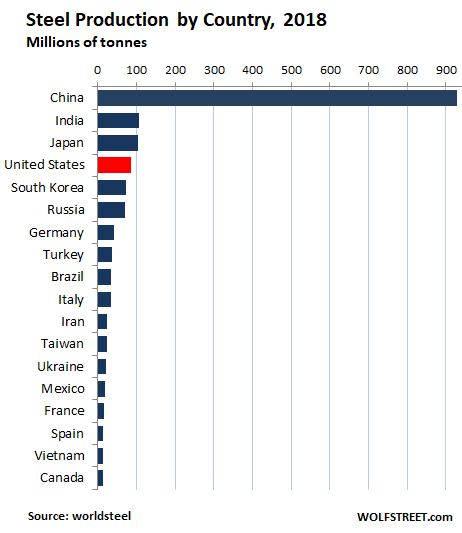
Steel production was key to great power status


In recent history steel was the most important thing for winning wars. Notice how the top four producers of steel from 200 years ago are permanent members of the UN security council?


The missing permanent member is China, which now produces quite alot:
Image result for country comparison steel production

However these days steel isn't the most important thing for winning wars. Information technology for intelligence gathering, disimformation, smart weapons command and control and many other things is critical. This is why a lot of the China - US trade war revolves around the US trying to prevent too much information technology transfers (as well as protecting strategic US steel & alumunium industries from Chinese undercutting). More to follow.

Wednesday, 7 November 2018

The problem of Consciousness and the Singularity

I've put a talk together on consciousness & individuality : what these concepts are and how technology will impact them
Youtube video of talk here 

Tuesday, 31 July 2018

Bostom bombers radicalisation memetic cook book

I've been following the boston bombers with great interest.

Stratfor is of the opinion that Inspire magazine helped radicalise Tamerlan as well as give him the knowledge for creating rudimentary explosive devices.


First off, what do I mean about radicalisation in the context of terrorism. Well fundamentally it's about using a person to carry out terror by indoctrinating them into believing it is a righteous cause worth dying for. They are a pawn, or to use Dan Dennett's excellent example an ant:


Dennett's analogy talks about the


Is there anything that can be done about Internet-enabled radicalization?
Authorities assessing the motivations of the bombing suspects appear convinced that Tamerlan and his younger brother, Dzhokhar Tsarnaev, were self-radicalized, “lone wolf” terrorists. Just as they may have gotten their recipe for pressure-cooker bombs from the Internet, so, too, it looks as if they entered cyberspace to indoctrinate themselves with ideas that justified blowing up innocent people.


The obscure Russian jihadist whom Tamerlan Tsarnaev followed online
To summarise, he was a nobody terrorist fighting for Dagastani independence from Russia who put out a few youtube videos

The boston bombings give an interesting insight into islamic radicalisation without any exposure to external networks

Timerlan the older brother had been watching radical preachers who were talking about the need for non-arabs to be warriors for allah.

he is named after a non-arab warrior who ruled a great muslim empire which included chechnea

http://en.wikipedia.org/wiki/Timur

http://en.wikipedia.org/wiki/File:Timurid_Dynasty_821_-_873_(AH).png


http://blackflags1.blogspot.com.au/

kyrgyzstan


YouTube account that appears to have been run by Tsarnaev includes a playlist devoted to "terrorism", including one video in English titled The Emergence of Prophecy: The Black Flags from Khorasan. He also maintained a playlist devoted to Islam and one devoted to Timur Mutsuraev, a Chechen singer who sang of the republic's battle for freedom from Russia.


http://www.bostonglobe.com/metro/2013/04/19/relatives-marathon-bombing-suspects-worried-that-older-brother-was-corrupting-sweet-younger-sibling/UCYHkiP9nfsjAtMjJPWJJL/story.html

timerlan

radicalisation

terror


Allah's Mountains: The Battle for ChechnyaThe I.D. Forger: Homemade Birth Certificates & ​Other Documents Explained, and How to Win Friends & Influ​ence People, among other works:


latest stratfor - CIA funded radicalisation of tamerlan?
http://www.stratfor.com/geopolitical-diary/izvestias-report-and-boston-bombing

http://www.infowars.com/tamerlan-tsarnaev-attended-cia-sponsored-workshop/?utm_source=twitterfeed&utm_medium=twitter

http://www.washingtonpost.com/blogs/worldviews/wp/2013/04/24/the-obscure-russian-jihadist-whom-tamerlan-tsarnaev-followed-online/


stratfor on bombing and inspire magazine


inspire magazine


memetics

dennet on dangerous ideas


kids = ant all terrain vehicle