Monday, 19 March 2012

Post-postmodern state: Corporates and Intellectual Property

I read Friedman's article on where Japan is heading and thought I'd try and visualise what a post-postmodern state could look like taking into account technological change, specifically greater thought integration of individuals and a larger proportion of GDP being comprised of information goods and services. Here's the paragraph that got me thinking:
There also remains a third possibility: that Japan could pioneer a technologically advanced society for the post-consumer age in which it manages both a sustained increase in production despite decreasing consumption and sets an example for many other countries facing similar demographic declines (though it is hard to tell what such a post-postmodern state would look like).  
First off, I'd argue it's a misnomer to suggest consumption has been falling in Japan during its 'Lost decade', the quantity of information goods consumed has increased exponentially. A majority of this consumption cannot be monetized as it isn't tied to rent-able intellectual property. I'm going to go out on a limb and say eventually it will be tied to intellectual property and the growth of the real economy will be linked more directly to the growth in information goods.

In my post-postmodern state, corporations will survive as will intellectual property, with corporations retaining responsibility for IP creation and dissemination. Also, governments will continue to become more 'Orwellian', increasing the behavioural conditioning and surveillance of individuals. This goes against the grain of a lot of free-market libertarian progressive thinkers but I will add some fat to my argument later on. First off here's more the mainstream view:

Ben Goertzel - Will Corporations Prevent the Singularity?
Charles Stross, in his wonderful novel Accelerando, presents an alternate view, in which corporations themselves become superintelligent self-modifying systems—and leave Earth to populate space-based computer systems where they communicate using sophisticated forms of auctioning.   This is not wholly implausible.   Yet my own intuition is that notions of money and economic exchange will become less relevant as intelligence exceeds the human level.  I suspect the importance of money and economic exchange is an artifact of the current domain of relative material scarcity in which we find ourselves, and that once advanced technology (nanotech, femtotech, etc.) radically diminishes material scarcity, the importance of economic thinking will drastically decrease.  So that far from becoming dominant as in Accelerando, corporations will become increasingly irrelevant post-Singularity.  But if they are smart enough to foresee this, they will probably try to prevent it. 
The thing is, contemporary corporate organisms are trying to transition from the control of production, trade and consumption of material goods, to a similar system for the production, trade and control of intellectual property! Once you realise the marginal cost for the propagation of information is almost zero, you realise IP is not related to scarcity but rather controlling what gets created and how it is disseminated. Here's some more libertarian thinking, Stephan Kinsella on IP:
But IP is widely seen as basically legitimate. There have always been criticisms of existing IP laws and policies and many calls for "reform." But I became opposed not just to "ridiculous" patents and "outrageous" IP lawsuits, but to patent and copyright per se. Patent and copyright law should be abolished, not reformed. The basic reason is that patent and copyright are explicitly anti-competitive grants by the state of monopoly privilege, rooted in mercantilism, protectionism and thought control. To grant someone a patent or copyright is to grant them a right to control others' property − a "negative servitude" granted by state fiat instead of contractually negotiated. This is a form of theft, trespass, or wealth redistribution.
I think Stephan has a point, IP law is inefficient but what could it be replaced with? As soon as you have a piece of intellectual property being created for more than the pure interest and enjoyment of the inventor/artist then there needs to be a reward. This especially applies to a piece of IP which requires a team of people to produce. In the corporate model an individual may be tasked with the creation of a 'piece' of a puzzle which doesn't interest them but still must be produced, economic incentives are the primary form of motivation in this scenario. Arguably Only when thinking power (ability to absorb, create and distribute information) is no longer scarce would economic regulation of IP no longer be needed (and how would you define thinking power scarcity? there is always something to think about).

The more interconnected the team members are which are producing a good, the more they function as a single organism, the higher the quality of the IP that can be produced, the sum of the parts is greater than the whole. I don't think it makes a difference whether this high level of interconnectedness occurs within some kind of anarcho-capitalist 'free-market', our current corporatist model or even via an Orwellian totalitarian political structure. In each case you have a set of thought connected individuals functioning as an unconscious mind, with its information feed regulated by data-mining super-computers (big brother Google, functioning as the eyes and ears). 

Eventually these hives may obtain greater consciousness, but that might not be needed, in fact it might not even engage an individual's conscious mind, but rather unconscious thought processes within different individuals will communicate with each other (they already do: culture, manner, feelings etc.). Barry Adams says:

There are strong indications that the subconscious mind, those thought-processes that by their very definition we are unaware of, are actually responsible for many, if not most, of our intellectual capabilities. Our subconscious mind might even be making most of our decisions.
The theory goes that our brains, over many millions of years, evolved a very capable subconscious mind that ensured our survival. The conscious mind is a relatively recent development, merely the icing on the cake, the latest addition to our brains. (An addition that, on the enormous time-scale of evolution, has yet to prove its long term value.)

I think these emergent corporate minds will operate within a political/economic model which incorporates free-market forces regulating corporate entities with a splash of Orwellian thought policing. The financial markets will continue to be the impersonal (for a while at least) forces driving the globe, mixed with a hybrid corporate government political structure. Corporates will retain responsibility for increasing economic output (which will mainly be IP generation and distribution), and governments will increase the behavioural regulation of individuals.

Why Corporates will survive:
Libertarians tend to see big corporates and big government as economically inefficient, but what they do show as an increase the hierarchy, complexity and centralised decision making which is identical to nature. Greater hierarchy means greater complexity, greater complexity means greater fitness - or so the evolutionary paradigm goes. If you strip down corporates and governments leaving decision making to 'free market forces' you are really just transferring decision making from one elite to another. The libertarian free market world would require more complex and overarching financial control mechanisms which in the end would replicate the complexities of corporate and government organisms.

Why government will become more 'Orwellian'
George Orwell's 1984 with it's totalitarian state was right on the money, however it is proving a much nicer place to live then he thought. Sure we live in a constant state of war, but we have small manageable wars which have little material impact on us. We don't quite have 'thought police' but the regulation of human behaviour is increasing through education and media which allow the state to build the kinds of individuals it needs. Concern has been raised by the large increasing of spying on the individual but I would argue this is required. The problem is as technological development increases the amount of damage an individual can inflict on society increases (viruses, terrorism etc.), the only way to prevent this is through behavioural conditioning, and surveillance.

Wednesday, 29 February 2012

Stratfor's Reva Bhalla - Take control of him

Here's some light-hearted analysis of Reva Bhalla and the infamous 'Take control of him' quote that's doing the rounds at the moment with the release of the Stratfor emails through Wikileaks - The Global Intelligence Files (mostly a snore-fest).


Reva Bhalla - Stratfor's tidy looking talking head

So the much quoted email line is:
"[Y]ou have to take control of him. Control means financial, sexual or psychological control... This is intended to start our conversation on your next phase" – CEO George Friedman to Stratfor analyst Reva Bhalla on 6 December 2011, on how to exploit an Israeli intelligence informant providing information on the medical condition of the President of Venezuala, Hugo Chavez.
She's young and inexperienced, in her first job out of uni, but she does what she's told by her boss which is all you really want in an employee.

Reva joined Stratfor straight from university, a political sciences major. Maybe she got an interview with BCG but her math wasn't up to scratch, or more likely she couldn't get an internship stuffing leaflets in envelopes for John Kerry's presidential campaign. Meanwhile George has founded Stratfor and needs some cheap labour and brings her on as an intelligence analyst. If they can't splash out $40k on email encryption software I don't think the salaries have been flash, especially not for kids straight out of school. Anyway Reva has done her time with the fledgling company and is starting to get a bit of limelight.

Reva has been featuring heavily in Stratfor's online video reports, which is pretty much like being a news anchor but on a tiny budget. Now I can't comment on her ability as an analyst, but her ability to look hot and sound intelligent while reading some bullet points is her real value to the company. Don't get me wrong I like a Fox News blonde bombshell as much as the next guy but Reva is allowed to say smarter things then them.

Reva's now the Director of Analysis, according to linkedin. She was Middle East Analyst last year so I'm guessing after the Christmas day stolen email shit-storm George decided to give her a better title to alleviate her concerns that his entire business might be going down the drain... Actually it has changed again, now she's Vice President of Global Analysis


I'm not sure whether director or VP sounds better, either way I'd buy her a drink.


Maybe I'm being a bit harsh on her? The fact Reva claims on her linkedin to be an expert in the Middle East, South Asia, Latin America, Iran-Hezbollah-Syriah Nexus, Al Qaeda, Iran, Turkey... at the tender age of 20 something tells me to take everything she says with a grain of salt. Who does she think she is? Henry Kissinger?

Anyway back to George's advice on how to deal with the Israeli intelligence analyst:

"[Y]ou have to take control of him. Control means financial, sexual or psychological control..."
I'm reminded of a Joy Division song - She's lost control 
Confusion in her eyes that says it all.
She's lost control.
And she's clinging to the nearest passer by,
She's lost control.
And she gave away the secrets of her past,
And said I've lost control again,
And of a voice that told her when and where to act,
She said I've lost control again.
George is the voice!

So maybe she sent the Israeli a few topless mirror shots off her iPhone with some naughty sext messages. Good advice George, I think he has been reading some Cosmo:


Has it been a little less than thrilling in the bedroom recently? You’re getting off, but he’s not trying anything new or exciting. That’s actually pretty common with couples who have been together for a while. See, once a guy finds moves that make you climax, he’s afraid to veer away from those and risk you not having an orgasm. The next time he goes into auto-pilot, whisper something naughty you want to try into his ear and tell him how much it would turn you on to try it, says Marty Klein, PhD. By telling him in the moment, not way before, he won’t have time to worry about whether or not the move will work or if he’ll do it right. He’ll be so caught up in the heat of the moment that’ll he try almost anything you tell him to.

Sunday, 1 January 2012

The managerial technocratic aristocracy

So according to these citigroup memos there is a Managerial Technocratic Aristocracy in the Anglosphere paying itself massive salaries and making zillions from start-ups. The anglosphere countries function as Plutonomies, while other western nations are more egalitarian.

Characterizing the U.S. Plutonomy: Based on the Consumer Finance Survey, the Top 1% Accounted For 20% of Income, 40% of Financial Wealth and 33% of Net Worth in the U.S. (More Than the Net Worth of the Bottom 95% Households Put Together) in 2001

In addition the nature of the economic elite has changed from more of a feudal model of deriving income from owning land and capital to one of high salaried executives and billionaire entrepreneurs:

The Metamorphosis of the Highest 1% of Income Earners in the U.S.: from Rentier Rich to a Managerial Technocratic Aristocracy


Now fundamentally as a species we are egalitarian by nature, is what is happening unnatural or even immoral or is it just the pareto principle playing out along with suitable financial incentives for business leaders and technological innovators? I don't know myself, however I do think most individuals don't need millions / billions of dollars as motivation to be productive.


In saying that,having a lot of wealth in the hands of a few may seem unfair, but I would argue, only if it adversely affects the human condition of the 99%. Keep in mind 99% of tennis grand slams are won by 1% of tennis players, 99% of blog entries are produced by 1% of bloggers (I'm making the numbers up), etc, etc. My point is it is natural to have an elite dominating any given domain due to specialisation.

This isn't something trivial as tennis however, our wealth has a large impact on our quality of life. We in the west aren't that bad off, sure you could have more toys but I would argue as long as we retain open access to the internet & information goods then the quality of human experience will remain comparable across the board. As information goods/services consumption continues to grow as a proportion of GDP then as long as we all have open access to a large chunk of them, inequality wont be as bad as the numbers look. Yes their will be material good inequality but not huge inequalities in terms of the human experience / quality of life which will shift more and more to the consumption of information, bypassing tangible goods. Given the marginal cost of propagating information goods/services for consumption is near zero, in the long run this material imbalance will cease to matter (as much), provided patents / intellectual property law is reformed.

The real worry then is if these Anglo Plutonomies manage to block access to information goods/services in order to further enrich the financial elite. The system is trying to clamp down on intellectual property & internet access (SOPA) but even if it does, the capital creation fluctuations introduced by newly patented technology will grow to a point where the markets will lose their ability to accurately measure value and capital will become meaningless. If Google can create 200 billion of market cap mainly down to a patented PageRank algorithm, then things are going to get out of control when some real information goods/services start appearing. So this may be the 'last gasp' of the financial elite.


On a tangent to finish off, from the same Citigroup report:

But the balance of power between right (generally pro-plutonomy) and left (generally pro-equality) is on a knife-edge in many countries.... A collapse in wealth in the plutonomies, felt by the masses, and/or prolonged recession could easily raise the prospects of anti-plutonomy policy.


This report came out in 2006 before the GFC.. Oh the irony (Occupy Wall St, we are the 99%)... No wonder Citigroup lawyers fought so hard to suppress this report.

Saturday, 5 November 2011

An argument against Chinese economic collapse

Investment in telecommunications & information technology will prevent the economic collapse of the modern Chinese state.  

George Friedman, stratfor founder, has long argued that China is doomed in the long run due to the wealth disparity between the coastal region and the interior. He believes this wealth disparity will lead to political instability and the collapse of China.

His argument: The cost of transporting goods determines how wealthy a region can be, coastal regions on ocean trade routes can be rich while internal regions with no river transportation network will be poor (water is the most cost effective way of transporting goods). He sees the growing wealth disparity leading to political instability (as it has in the past) which can only be resolved with a Maoist type equalisation of wealth, In Mao's case he made everyone equally poor with his bad policies but maintained China's political integrity against western encroachment.

I think Friedman's argument may have overlooked information networks. The internet is a very low cost way of transporting information, furthermore the percentage of GDP which is made up of information goods and services is increasing and will continue to increase. I think the consumption of information goods and services will reach a point where it accounts for over 80% of GDP in the next 20-30 years. I can't back this up with hard facts and this prediction is reliant on an exponential growth in information technology as postulated by Vernor Vinge (accelerating change) and  Ray Kurzweil (law of accelerating returns). These predictions are both to a large part based of Moore's law. My basic argument would be, with the exponential growth in computing power, the proportion of GDP that would be made up of information goods will increase.


China will have 1.3 billion people all speaking the same language as their 'base network' for information creation and propagation, giving them the critical mass to compete with the English speaking west. Metcalfe's law states that the value of a telecommunications network is proportional to the square of the number of connected users of the system meaning the number of human minds generating information on China.Net will become the primary measure of economic strengthIn this case, provided China has a solid internet infrastructure, the quality of life of its inland citizens should not be that much worse than those in the coastal regions. It will be worse in terms of the consumption of tangible goods, but the information goods and services should help alleviate this (at least enough to prevent political upheaval).


China invested a total of 4.3 trillion yuan (630 billion U.S. dollars) in Internet infrastructure construction from 1997 to 2009 (see here), By the end of 2009 the number of netizens in China had reached 384 million, 618 times that of 1997 with an annual increase of 31.95 million users. Furthermore the Chinese white paper on internet policy issued last year states China intends to make the internet accessible to 45% of its population by 2015.


As you can see, provided English continues its colonization of the European Union, West.Net and China.Net will have approximately the same number of people interacting in the same language. A side question: will India.Net be dominated by English or Hindi?

Friday, 6 May 2011

US targeted killings: Osama - Yamamoto comparison

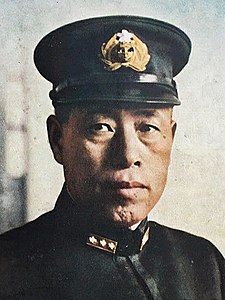
Given the recent media fire-storm over the killing of Osama bin Laden, I thought it would be interesting to compare and contrast the operation to the killing of Admiral Yamamoto, a historic American ‘enemy number one’, during WWII. Both operations involved the targeted killing of a figurehead/leader responsible for an 'unprovoked' attack on the United States. Both killings were for home front propaganda,  and both showcase the exceptional intelligence gathering capabilities of the United States.


Edit: It turns out US Attorney General, Eric Holder has used the same comparison as a legal justification of Osama's assassination (see here). To misquote Voltaire, "God is always on the side of the big battalions."


Similarities

Isoroku Yamamoto was commander-in-chief of the Japanese Navy and was responsible for planning and executing the Japanese attack on Pearl Habour, which brought America into the WWII. Osama bin Laden was the  founder of al-Qaeda and held overall responsibility for the September 11 attacks, which unleashed America's War on Terror.

Both targeted killings were largely for propaganda / moral boosting purposes, not for any tactical reason. Osama had been so far removed from Al Qaeda command and control he no longer had any tactical significance to the organisation, while in Admiral Yamamoto’s case, the Japanese had already lost the crucial Battle of Midway in which the allies had destroyed a majority of Japan’s carrier fleet, eliminating a large chunk of their capability in the pacific, which lead to Japan’s eventual capitulation. 


Both attacks were executed using an exceptional military intelligence gathering apparatus, which made the tactical execution of both missions as difficult as shooting fish in a barrel:

With Yamamoto, allied code breakers had deciphered a Japanese radio message of the scheduled tour Yamamoto was planning to make to the Solomon Islands and New Guinea, which included his scheduled destinations and flight times. President Roosevelt ordered the Navy to "get Yamamoto.”  and it was only a matter of sending a bunch of fighters to intercept his aircraft and shoot him down.

With Osama, the interrogation of a terrorist got the name of one of Osama’s courier’s. Next a Pakistani spy saw him in Abottabad, spy satellites used facial recognition technology to identify Osama exercising in the back yard [Edit: That might be a load of BS, latest take was it was Osama's oldest wife who snitched, pissed off he only banged his youngest wife]. President Obama ordered the Navy to “get Osama.” once again, the rest was timing. Navy SEALs had been practising the operation over a month before the raid took place, using a custom built replica of his compound! The date chosen had more to do with Obama’s re-election campaign then anything else.

Differences

The main difference between the two operations relates again to the desired propaganda / public relations outcomes of the killings. 

The killing of Yamamoto was quite impersonal, fighters shoot down his plane, it crashes, and he dies. The Japanese navy reports he is dead and this cannot easily be hidden as he is not in hiding like Osama was.

Obama wanted proof that Osama he was dead, using a B2 bomber to flatten his house would have achieved the same tactical purpose of killing Osama, but this was a PR campaign and it would not have achieved the right results as it may have been impossible to identify his body,  in which case his death could be denied by Al Qaeda. So instead a hit squad was sent to kill him and bring the body back as evidence.

The problem with the hit squad approach is it can make America seem like the bad guy, when you send 25 SEAL’s in to kill an unarmed man in cold blood in front of his daughter and wife, it doesn’t look right, even if it is Osama.

So that’s when your press spin doctor’s make up a ‘fire fight’ (which didn’t happen), Osama being armed (not true) and using his wife as a human shield (also not true) in order to vilify the man and make a point blank cold blooded execution palatable to the public.

Washington spin doctors probably would have got away with it, if it hadn’t been for the fact one of the SEAL’s helicopters had a technical malfunction and could not take off. The plan had been to use that helicopter to transport the woman and children left behind away so that they could not tell the true story of what happened to the Pakistani intelligence service. The reason the story changed from what was originally told by the US administration to what actually happened has nothing to do with 'fog of war' but is because Osama’s daughter was an eye witness in his execution.

What this means for the future
 
The irony is if a B2 bomber had flattened the compound, Osama would be dead along with all the women and children (as unfortunate collateral damage) and yet it would sit more cleanly on our collective conscience then if we go in a shoot someone at point blank range. The bombing de-personalises the killing but achieves the same purpose, in the same way Yamamoto's killing was depersonalised by being in a plane that was shot down.


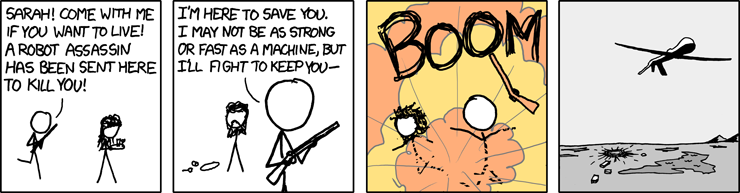
The implications of this are scary, hunter-killer robotic drones such as the MQ-9 Reaper are being used with great tactical success in the Pakistan / Afghanistan region to target militant leaders, and no one bats an eyelid about it. But if you were to think about it in reference to say - The Terminator - as http://xkcd.com does:


Once we can make humanoid robotic soldiers like the terminator to do our dirty-work we will. If a robot had gone into the compound and mown down Osama and his family you again depersonalise what is happening. Killing of the family could be an ‘unfortunate programming error’. Not only that, you no longer need highly trained troops that while brainwashed into efficient killing machines, still need to believe what they are doing is right. If the governing elite control both the media and the robotic killing machines they can pretty much do anything they want. All the human rights we think we have won can be lost to the doublespeak of the state (espousing human rights and freedoms while taking them away). Human life once again could be on track to being worthless.

Friday, 18 February 2011

Unrest in Middle East - history repeating

While looking at Stratfor's map of social unrest in the middle east today, it struck me that ALL of the Arab portions (Iraq and Palestine-Israel are US clients) of the former Ottoman Empire are experiencing unrest:
 

Former territories of the Ottoman Empire
The Arab portion of the Ottoman Empire was split into nation states by the Allies after World War One. Puppet monarchs friendly to western interests were installed, some of which are still around.

Lets look at the similarities between the Ottoman Empire and the nation states of today:

The Ottoman Empire was divided into a number of administrative units called Eyalets, which are similar to the nation states that now exist, each Eyalet was ruled by a governor appointed by the sultan. These governors were notoriously corrupt as was the rest of the government sector. Bribes were required for everything. Government officials would spend their career building up vast ill-gotten fortunes, often used to 'buy' their next promotion.

So what about social unrest in the Ottoman Empire? From Britannica:

Social Unrest
These conditions were exacerbated by large population growth during the 16th and 17th centuries, part of the general population rise that occurred in much of Europe at this time. The amount of subsistence available not only failed to expand to meet the needs of the rising population but in fact fell as the result of the anarchic political and economic conditions. Social distress increased and disorder resulted.

We have exactly the same conditions in the contemporary Arab states - massive population growth, very high unemployment (especially amongst  the young), stagnating economies and very corrupt governments with leaders amassing vast fortunes from corruption. The recently deposed president of Egypt - Hosni Mubarak - is estimated to be worth between 40 and 70 billion US dollars.

The history of the middle east is that of governors and despots being cyclically overthrown by stronger strongmen. Alexander the Great took over a corrupt Persian state apparatus from Darius. Hannibal got dealt to by Scipio, Mark Antony and Cleopatra got dealt to by Octavian. The Romans held the middle east until they were dealt to by Vandals, Arabs and Turks, who were just as bad. Perhaps geopolitical theory would argue the geography of the middle east favours corrupt dictatorships?

Tuesday, 15 February 2011

Trade-off between quality of dream and level of lucidity?

I've been having a number of semi-lucid dreams. These are dreams in which I am aware I am dreaming but still play along with the plot of the dream. I have been wondering why I do this, as opposed to performing experiments on my dream scape.


Dreams can be fun: the have intense plots where you can do outrageous things that you can't do in real life. This I am beginning to believe, is the reason I remain semi-lucid. When thinking about my dream experiences I am beginning to notice the more lucid I am, the less activity there is in the dream. As my lucidity increases the stimulus in my dream environment decreases. I stay only semi-lucid because I want to 'ride the wave' of my dream.


This leads me to think that perhaps as the lucid conscious process ramps up it starves resources from the dream construct, almost like there is a trade-off between the two - only so many brain resources. As in a sense reality is a constructed story, perhaps when we don't have a majority of reality construction outsourced to the real world there has to be a trade-off of what can be achieved with the brains finite resources.


Its almost like the high level constructs the reality and the reptilian experiences it.